Skip to content



The US-Iran peace deal is suddenly one of the biggest diplomatic stories in the world. After war pressure, regional mediation, and public threats, the Trump administration says a deal is within reach. Trump has said the United States has a deal that ensures Iran will never have a nuclear weapon. But Iran has pushed back and says no final decision has been made. That means the moment is historic, but it is not finished.
Quick Facts
- Trump says the United States has a deal that would stop Iran from getting a nuclear weapon.
- Iran says no final decision has been made and talks are still under review.
- Reports say the deal text is largely agreed but final approval is still pending.
- Reported terms include sanctions relief, reopening the Strait of Hormuz, and action on Iran’s highly enriched uranium.
- Pakistan, Qatar, Saudi Arabia, and the UAE have all been linked to de-escalation efforts or mediation channels.
- The White House continues to hold a hard public line that Iran cannot have a nuclear weapon.
Why this moment feels bigger than a normal ceasefire
This story feels bigger than a simple ceasefire because it is being framed as a wider diplomatic breakthrough. It could reshape the war, sanctions policy, Gulf shipping, and Iran’s nuclear future at the same time. Reports suggest the deal under discussion includes reopening the Strait of Hormuz, easing sanctions, unfreezing Iranian funds, and beginning a process tied to Iran’s highly enriched uranium. That makes it far more important than a short term pause in fighting.
What also makes it dramatic is the gap between public confidence and official caution. Trump is speaking like a breakthrough is already here. Iran is speaking like it is still reviewing the terms and protecting key red lines. That tells you this is not a finished handshake moment yet. It is a near-deal sitting inside a trust problem.
Why Trump is selling this as strength
Trump is not presenting this as compromise. He is presenting it as proof that pressure worked. His message stays focused on preventing Iran from obtaining a nuclear weapon. That fits both his political style and his national security message.
Why Iran is being more careful
Iran has to show its own public that it did not surrender under pressure. That is why officials are emphasizing review, unfinished approval, and red lines instead of celebrating a done deal.
Why the difference matters
A deal can be close and still collapse. That is the real tension in this story.
What is reportedly inside the US-Iran peace deal
The most widely discussed framework includes four major parts. First, a pause or extension that helps stabilize the battlefield. Second, steps to reopen the Strait of Hormuz and reduce pressure on global energy flows. Third, sanctions relief or access to frozen Iranian assets. Fourth, a process aimed at limiting or removing Iran’s highly enriched uranium so the program cannot quickly produce a bomb.
This is why diplomats and markets are watching so closely. If the Strait reopens more fully and sanctions pressure eases, the result would affect oil markets, shipping routes, and regional security all at once. There are also reports that billions of dollars could be unlocked for Iran as part of a broader de-escalation arrangement. Even that possibility shows how much money and regional leverage are tied to the diplomacy.
The nuclear side remains the hardest part. Trump’s public message is simple. Iran cannot have a nuclear weapon. Iran’s message is also simple. It will not surrender its core interests. That leaves negotiators trying to turn slogans into inspection rules, timelines, sanctions language, and technical enforcement.
The sanctions question
Iran wants real economic relief, not symbolic wording. That means access to funds, oil sales, and reduced pressure on trade.
The uranium question
The United States wants a structure that clearly blocks a fast nuclear breakout. Reported drafts point to action on Iran’s highly enriched uranium over a defined period.
The hidden issue
Even if both sides agree on text, enforcement is the harder battle.
Who helped bring the sides this close
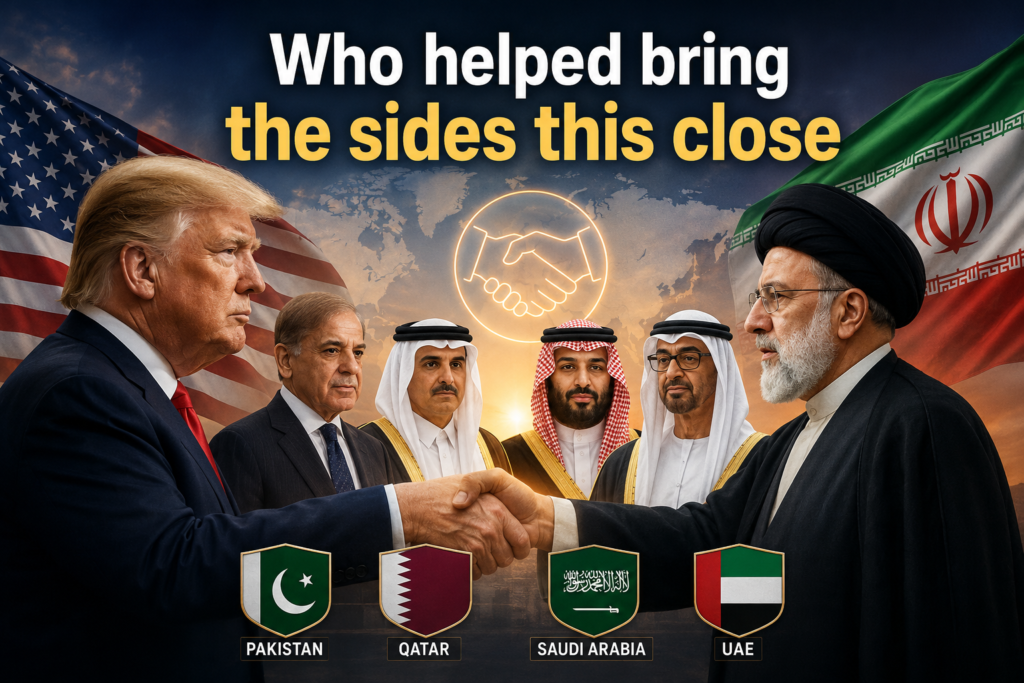
This is not a one-country diplomatic show. Pakistan has publicly signaled momentum. Reports also point to Saudi Arabia, Qatar, and the UAE as part of a wider mediation effort. That means the US-Iran peace deal is not just a Washington and Tehran story. It is also a Gulf and regional diplomacy story.
That matters because both Washington and Tehran need outside help. The United States needs regional support to make any ceasefire durable. Iran needs off-ramps that do not look like humiliation. Mediators create that space. They allow messages to move when direct trust is weak. They also help with practical diplomacy such as sequencing money, shipping, messaging, and verification.
It also explains why the story has moved so fast. Once several regional players decide that escalation is too dangerous, diplomacy can suddenly jump from impossible to urgent. But urgency can also create fragile paperwork. Fast deals often need stronger guarantees later.
Why Pakistan matters here
Pakistan appears to be using public messaging to show momentum and keep both sides moving.
Why Gulf states matter too
The UAE, Qatar, and Saudi Arabia all have direct security and economic reasons to stop a wider regional conflict.
The deeper truth
When neighbors start mediating this hard, it usually means everyone believes the alternative is worse.
Can this really end the war
Maybe, but not automatically. A near-final text is not the same as a durable peace. Fighting, mistrust, and regional instability can still undermine the process. That means the conflict has not fully shifted from battlefield logic to settlement logic yet. One strike, one political backlash, or one fight over implementation could still derail the agreement.
There is also the Israel question. Reports suggest Israel is not a direct party to the talks and remains skeptical, especially on missile limits and the wider regional threat picture. That matters because regional wars do not stay neatly contained when one major actor feels its security concerns were not fully addressed. So even if Washington and Tehran align on a draft, the region may still face serious aftershocks.
Still, this is the closest the sides appear to have come to a broad wartime arrangement in this phase of the crisis. Trump’s language, White House messaging, and the mediation effort all point to a real opening. Iran’s caution does not erase that. It simply reminds everyone that diplomacy is not finished until signatures are real and implementation begins.
What could still break the deal
A dispute over sanctions timing, uranium enforcement, or fresh military action could still blow it up.
What could save it
Fast approval, clear sequencing, and visible regional backing would give the deal its best chance.
The biggest test
The first weeks of implementation would matter more than the signing photo.
Why this is politically huge for Trump
If Trump turns this near-deal into a signed framework that holds, he will present it as one of the biggest foreign policy wins of his term. The White House has already been messaging Iran as a central national security threat while insisting Tehran cannot have a nuclear weapon. A breakthrough would let Trump argue that pressure, not prolonged war, forced results.
But the politics cut both ways. If the deal is announced too early and then stalls, critics will say the administration oversold a shaky draft. If sanctions relief arrives before the deal looks enforceable, opponents will attack it as weakness. That is why the administration’s confidence and Iran’s caution are both politically logical. One side wants credit early. The other wants concessions locked before celebration starts.
For American readers, this is why the US-Iran peace deal matters beyond the Middle East. It touches gas prices, military risk, nuclear policy, and the image of presidential power all at once. Very few diplomatic stories carry all four at the same time.
Why the messaging is so aggressive
Because both diplomacy and politics are happening at the same time.
Why this story will keep changing fast
Because the final answer depends on approvals that still have not been completed.
Bottom line
This is a breakthrough attempt, not a finished peace.
Final verdict
The headline story is real, but it still needs caution. There is strong evidence that the United States and Iran are close to a major diplomatic agreement, and Trump is openly presenting it as a breakthrough that would block an Iranian nuclear weapon and help end the war. But Iran says no final decision has been made, and approval is still pending. That means this is not yet a completed peace deal. It is a high-stakes near-deal with enormous consequences if it holds. Stay updated with the latest news on usnewspoint.com
FAQs
Has the US-Iran peace deal been officially signed?
No. Officials say the deal is close, but final approval is still pending.
What does Trump say about the deal?
Trump says the United States has a deal that Iran will never have a nuclear weapon.
What is Iran saying right now?
Iran says no final decision has been made and its red lines remain under review.
What is reportedly inside the deal?
Reported terms include sanctions relief, Strait of Hormuz reopening, and action on Iran’s highly enriched uranium.
Could this really end the war?
It could help end it, but only if the deal is approved, implemented, and not derailed by new fighting.